
Nail colors are easier to choose than most guides make them look. This guide covers the major color families, a simple undertone shortcut, and the two-color combinations that reliably work, so that by the end you can pick a shade for your skin tone, your occasion, and your season without defaulting to the same two bottles every time.
What are the most popular nail colors?
The most popular nail colors are the ones that survive every trend cycle: soft neutrals and nudes, classic reds, everyday pinks, and a rotating cast of seasonal shades. Neutrals win because they go with everything and suit conservative offices, weddings, and everyday wear. Reds win because a single shade can look polished at work and striking in the evening. Pinks sit in between, offering a softer version of red that reads fresh rather than formal.
Beyond that evergreen core, popularity moves with the seasons. Spring brings pastels and sheer finishes, summer brings brights and coral tones, fall brings deep burgundy, brown, and forest shades, and winter brings dark reds, navy, metallics, and glitter. None of these rotations replaces the core. Most people who are happy with their nails keep two or three trusted shades in rotation and add one seasonal shade at a time, rather than rebuilding their whole collection four times a year.
That is the useful way to read any “most popular” list. A shade is only popular in the sense that many people reach for it; it still has to suit your hands, your wardrobe, and the week you are about to have. The sections below give you a decision framework first, then the color families, then the combinations, so popularity becomes a starting point rather than a prescription.
How to choose a nail color
Start with your undertone, then your occasion, then the season. Undertones come in three groups: warm, cool, and neutral. Warm-leaning shades such as oranges, warm reds, and golds tend to flatter warm undertones. Cool-leaning shades such as blues, purples, cool pinks, and silvers tend to flatter cool undertones. Neutral undertones can wear both families comfortably. The honest caveat matters more than the rule itself: undertones narrow the field, they do not dictate it. If you love a shade that sits outside your undertone group, wear it anyway, especially in a sheer or muted version, which is far more forgiving than a fully opaque one.
Next, think about the occasion, because the same shade reads differently at work and at a party. For a conservative office, classy neutral nail ideas are the safest starting point: sheer nudes, soft beige, pale pink, and muted taupe look polished without drawing attention in a meeting. For a wedding, sheer and soft shades also work, with one metallic or glitter accent nail if the dress code allows it. For evenings and parties, deeper or bolder shades earn their place, because the lighting and the outfit can carry them.
If you are unsure where to start, clearish pink nails are a genuinely useful first step. A sheer pink evens out the look of the nail, suits almost every undertone, and works for work, weddings, and weekends alike. It is the shade to reach for when you want to look put together without making a statement, and it is an easy base for branching out later: once you are comfortable with sheer pink, try a milky nude, then a soft rose, then a deeper shade in the same family.
Season comes last, and it should be treated as a nudge rather than a rule. Deeper shades trend in fall and winter, pastels and brights in spring and summer, but personal preference overrides season every time. A dark burgundy in July is not a mistake, and a pastel pink in December is not a fashion crime. Choose the season’s suggestion when you want fresh inspiration, and ignore it when you already know what you like.
 ▶
The big nail color families
Neutrals and nudes
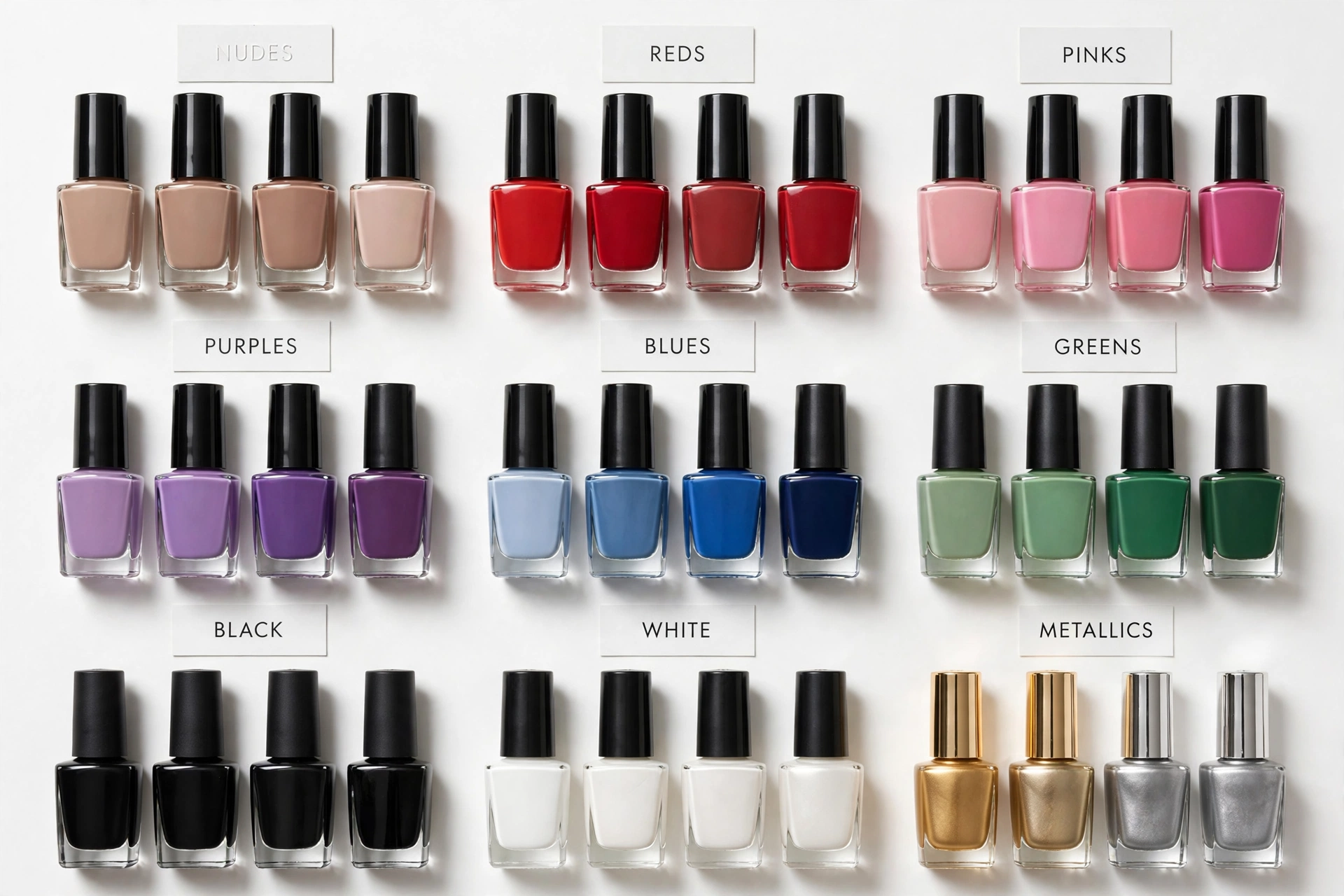
Neutrals are the workhorses of any nail color collection: beige, taupe, cream, soft brown, and sheer nude shades that sit close to the natural nail. Their strength is versatility. A neutral goes with every outfit, suits every occasion, and makes hands look neat without competing with rings, sleeves, or a bold outfit. The trick is matching the neutral’s undertone to yours: warm beige and caramel-leaning nudes suit warm undertones, while grey-leaning taupe and cool beige suit cool undertones. When the match is right, the shade looks like a better version of your natural nail rather than a layer sitting on top of it.
For everyday wear, classy neutral nail ideas are worth building a small rotation around: one sheer nude for bare-looking polish, one opaque beige for a more finished look, and one soft taupe for cooler days. Keep the rest of the set simple. Neutrals lose their quiet advantage when they are loaded with heavy glitter or competing accent nails, so let the shade itself do the work.
Reds and burgundies
Red is the most forgiving bold shade in the whole color map. A true red suits most skin tones, a warm brick red flatters warm undertones, and a cool cherry red flatters cool undertones. Burgundy, the deeper cousin, carries the same confidence into fall and winter and reads slightly more formal, which makes it a strong choice for evenings and special occasions. Both shades work at short and long lengths, and both survive chipping better visually than pale shades do, because a small chip in a deep shade is less obvious than one in a sheer shade.
Red also carries pattern well. A single accent nail with a small motif keeps a red set playful without turning it into a themed manicure, and red heart nail designs are the classic example: one or two heart accents on a red or nude base read romantic and deliberate, while hearts on every nail can quickly look busy. Keep the base shade dominant and the motif small, and red stays elegant rather than costume-like.
Pinks
Pink is the largest family in practice, because it stretches from sheer, barely-there washes to vivid hot pink. Sheer pinks are the everyday default: they even out the nail, suit work and weddings, and flatter nearly everyone. Milky pinks add a little more coverage while staying soft. Bright and hot pinks are the statement end of the family, best worn when you want the nails to be part of the outfit rather than a quiet background to it.
Within the family, two looks deserve a specific mention. First, clearish pink nails are the most reliable sheer option for anyone who wants a polished look with minimal color, and they pair well with a single glitter or metallic accent nail. Second, pink and yellow nails are a cheerful warm-weather pairing: soft pink with a butter-yellow accent, or a pink base with small yellow details, reads sunny without being loud. Pink is also the family where finish matters most, because the same pink looks completely different in a sheer wash, a creamy opaque coat, and a high-gloss finish.
Purples
Purple runs from soft lavender to deep plum, and it is one of the most versatile cool-toned families. Lavender suits spring and reads gentle and fresh. Mid-tone violet works year-round and pairs well with silver accents. Deep plum is a fall and winter staple that offers the depth of burgundy with a cooler, slightly more unusual edge. Because purple sits between blue and red, it can lean either way: blue-leaning purples flatter cool undertones, while red-leaning purples are more forgiving for warm undertones.
If you want a purple look with pattern rather than a solid shade, nail designs on purple give you plenty of room to play. A purple base with silver glitter, a lighter purple accent nail, or small white details all work, because purple is dark enough to make light details stand out and light enough, in its paler forms, to carry darker details. The one caution is contrast: very dark purple with black details can blur together, so keep the accent shade clearly lighter or clearly metallic.
Blues and greens
Blue is the cool family that surprises people most, because it ranges from wearable navy to playful sky blue. Navy is the workhorse: deep, elegant, and surprisingly easy to wear, especially with silver or gold accents. Sky blue and pastel blue are spring and summer shades that read fresh and light. Teal and forest green sit nearby and offer the same depth as navy with a slightly less expected feel. Green, from sage to deep forest, has become a genuine everyday family rather than a novelty, and muted greens in particular suit short nails well.
For a bolder blue look, blue and black nail designs are worth trying: navy and black together read sleek and evening-ready, especially with a glossy finish or a single metallic accent to stop the two dark shades from merging. The pairing works because the shades are close enough to look deliberate and different enough to create depth. Keep the design simple, one or two accent nails at most, and the combination stays sophisticated rather than heavy.
Black and white
Black and white are the contrast pair of the color map, and each works very differently on its own. Black is bold, glossy, and evening-ready; it shortens the visual length of the nail slightly, so it tends to look best at short to medium lengths or with a shape that adds length, such as almond or oval. White is bright and clean, and it makes nail art and small details stand out sharply, but it also shows chips and uneven application more than any other shade, so careful prep and a good top coat matter more here than anywhere else.
Together, black and white are a graphic, modern combination, and they carry small motifs beautifully. As an accent look, black nails with hearts are a good example of how to use the pair: a black base with one or two small white or red heart accents reads intentional and stylish, while hearts on every nail tip the set toward novelty. The same discipline applies to dots, stripes, and French-style tips in black and white: one strong idea, repeated sparingly, beats three ideas competing on one hand.
Metallics: gold and silver
Metallics are not colors in the usual sense; they are finishes that behave like colors. Gold reads warm and festive, and it pairs naturally with white, cream, navy, and deep red. Silver reads cool and clean, and it pairs naturally with black, navy, purple, and cool pink. Both work as full shades for evenings and parties, and both work even better as accents: a single metallic nail, a metallic French-style tip, or a thin metallic line can lift an otherwise plain set without changing its character.
For a classic metallic look, white and gold nails are hard to beat. A white or cream base with gold accents, or a gold accent nail against white, reads bright, celebratory, and wedding-friendly, and it suits both short and long nails. The key is restraint: metallics reflect light, so a little goes a long way. One or two metallic nails in a set of five will catch the eye; five metallic nails can overwhelm the outfit they were meant to complement.
Two-color nail combos that always work
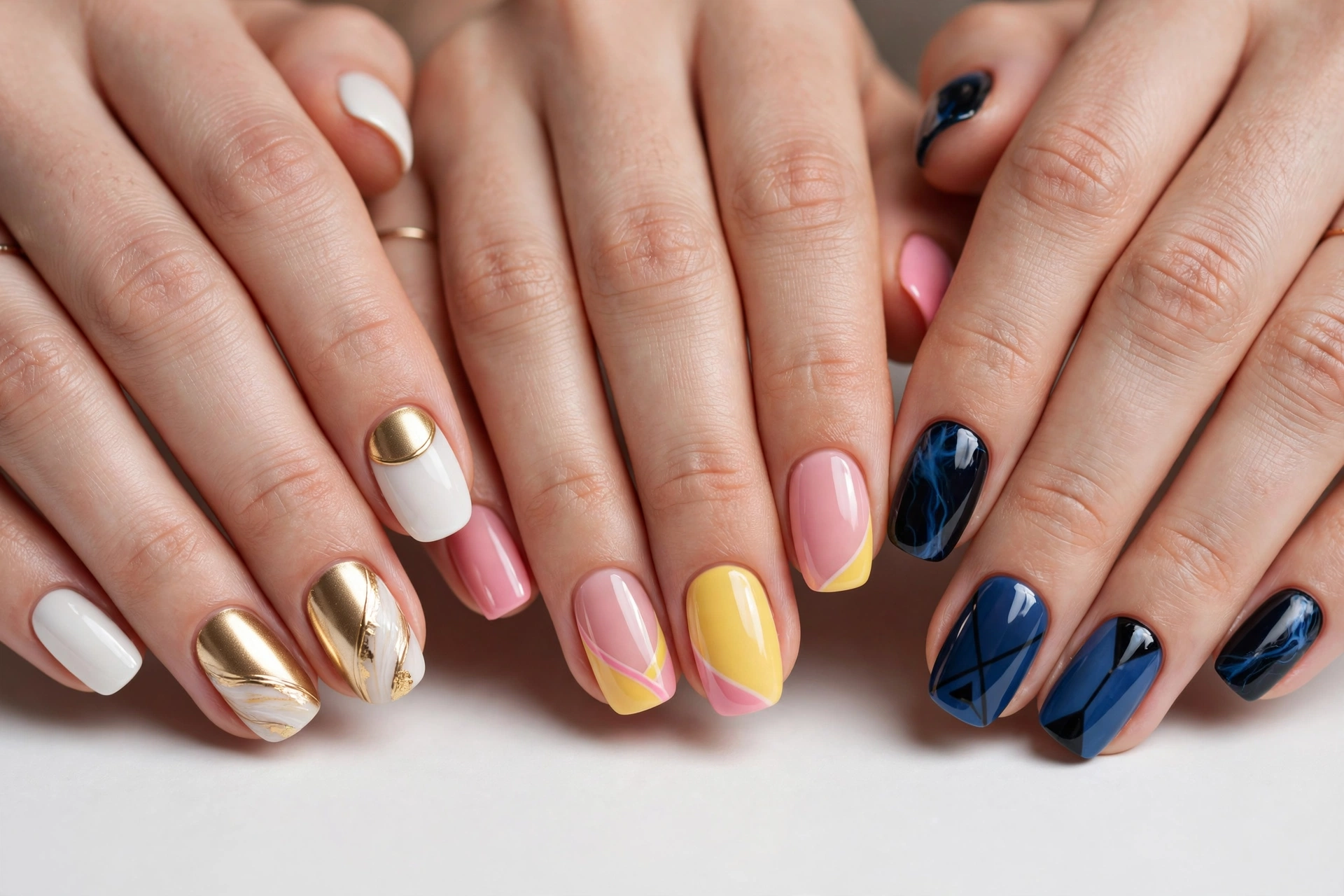
Two-color combinations work when the two shades have a clear relationship: they are either tonal, meaning close in depth and temperature, or complementary, meaning different enough to create contrast without clashing. The safest ceiling is two to three shades per set. Pair one dominant shade with one support shade, and let the dominant shade cover most nails. A purple base can also join a two-color set as an accent, and nail designs on purple work well with silver or white details when the purple is the supporting shade rather than the star.
| Combo | Mood | Best occasion |
|---|---|---|
| White and gold nails | Bright, celebratory | Weddings, parties, festive evenings |
| Pink and yellow nails | Cheerful, sunny | Spring days, summer holidays, casual outings |
| Blue and black nail designs | Sleek, evening-ready | Nights out, formal events |
| Black nails with hearts | Playful, graphic | Date nights, celebrations, accent looks |
After the table, a few honest notes help. Blue and black nail designs read boldest with a glossy finish, which keeps the two dark shades distinct; in a matte finish they can blur together, so add a metallic accent if you choose matte. Red heart nail designs also work as a single accent inside a two-color set, for example a nude base with red hearts on one nail, rather than as a whole set of hearts. And whatever the combination, test it on one hand first: two shades that look good in their bottles can look very different side by side on the nail, and a quick test saves a full removal.
Nail colors by season
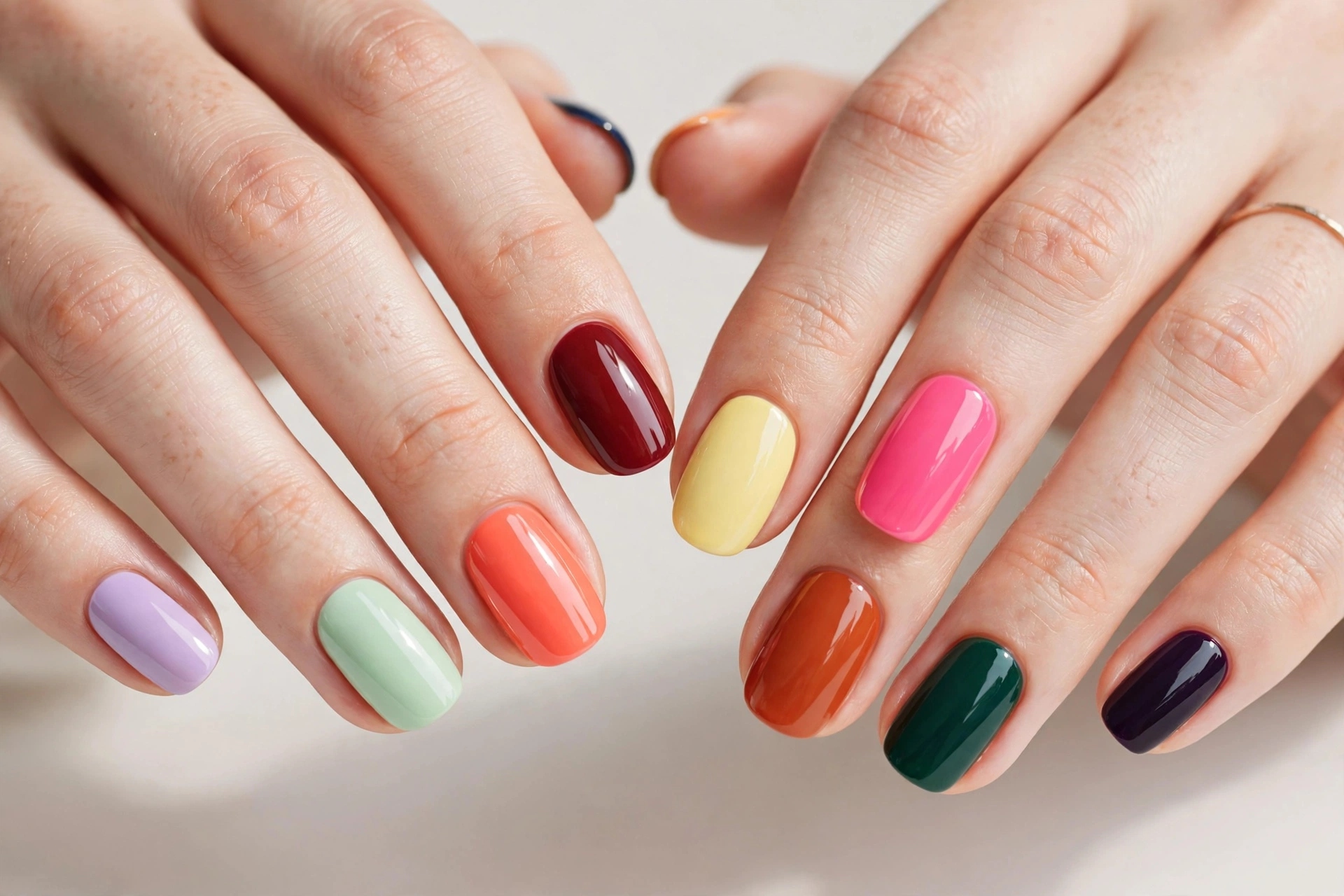
Spring is the season for renewal shades: pastels, sheer pinks, lilac, mint, and soft sky blue. The mood is light, so sheer and milky finishes suit spring better than heavy opaque shades. Pink and yellow nails fit spring particularly well, because the pairing captures the season’s brightness without needing a bold, saturated shade. Keep the set simple, one or two pastel shades at most, and let the lightness of the colors do the work.
Summer is the season for brights: coral, vivid pink, turquoise, sunny yellow, and bright orange. These shades suit tanned skin and casual outfits, and they can carry a bolder finish, including high gloss and a touch of glitter. The practical caution is sun and water: bright shades show wear from swimming and gardening faster than dark shades, so a good base coat and regular top-coat refreshes matter more in summer than in any other season.
Fall is the season for depth: burgundy, brown, forest green, burnt orange, and deep plum. These shades suit the heavier fabrics and darker palette of autumn clothing, and they look especially good in a glossy or creamy finish. The seasonal guide on the site covers fall looks in more depth, but the color principle is simple: go one or two shades deeper than your summer choices and the whole set will feel seasonally right.
Winter is the season for drama and sparkle: deep red, navy, black, metallics, and glitter. Dark shades suit evening events and festive occasions, and metallic accents feel natural rather than overdressed. A single playful accent fits here too: black nails with hearts as one accent nail inside a dark winter set add a small, deliberate surprise without breaking the season’s elegant mood. Winter is also the season when sheer and nude shades earn their keep as a rest from dark colors between events.
Finishes change the color
The same shade reads differently by finish, and this is the fastest way to change a color without buying a new bottle. Matte softens and mutes a shade, making bright colors look more modern and deep colors look more velvety. Glossy deepens and brightens, making reds richer and dark shades more dramatic. Chrome and metallic finishes add reflectivity, which makes light shades shimmer and dark shades gleam. Sheer finishes lighten everything, turning an opaque shade into a wash of color that is far more forgiving on uneven nails.
Finish choice also affects wear. Matte finishes tend to show marks and can look dull as they wear, while glossy finishes hide small imperfections better and are easier to refresh with a top coat. The site’s nail polish guide covers polish types and finishes in detail, so this pillar keeps the point to one paragraph: pick the shade first, then pick the finish that makes that shade behave the way you want it to for the occasion.
Mistakes to avoid when choosing a color
The first mistake is putting too many competing shades in one set. A hand with five different statement shades rarely reads as creative; it reads as undecided. Two to three shades, with one dominant, is the ceiling that keeps a set looking intentional. If you love white and gold nails, for example, let that pairing be the whole set rather than adding a third bright shade that fights it for attention.
The second mistake is ignoring undertone entirely, not in the sense of breaking a rule, but in the sense of picking a shade that fights your skin. A very cool pink on very warm skin, or a very warm orange on very cool skin, can make hands look tired rather than polished. The fix is small: shift the shade one step toward your undertone, or choose a sheer version, and the same color family usually works.
The third mistake is chasing every trend at once. Trendy shades are fun, and trying one new shade a month is a good habit, but rebuilding a whole collection around each trend is expensive and usually ends with bottles that are used once. A better habit is to keep your trusted core and add one trend shade at a time, worn for a full week, before deciding whether it earns a permanent place.
The fourth mistake is forgetting the occasion. A shade that is perfect for a party can feel wrong in a conservative office, and a shade that is perfect for a wedding can feel dull on holiday. Check the week ahead before you paint, not after. And a related mistake is overloading motifs: red heart nail designs lose their charm when every nail carries a heart, and nail designs on purple lose their impact when the purple itself is buried under competing details. Keep motifs to one or two accent nails, and the base color stays the star.
Frequently asked questions
How do I choose a nail color for my skin tone?
Start with your undertone. Warm undertones tend to suit warm reds, oranges, corals, and golds. Cool undertones tend to suit blues, purples, cool pinks, and silvers. Neutral undertones can wear both families. Then apply the preference test: if you love a shade outside your group, try it in a sheer or muted version first. Undertones narrow the field; they do not overrule what you actually like wearing.
What are the most classic nail colors that never go out of style?
Sheer nude, classic red, soft pink, and deep burgundy are the four shades that have survived every trend cycle. Sheer nude suits every occasion, classic red suits every season, soft pink suits every age, and burgundy suits every fall and winter. If you own only a few bottles, these four cover more situations than any trend shade will.
What nail colors are best for the office?
For the office, classy neutral nail ideas are the reliable answer: sheer nudes, soft beige, pale pink, muted taupe, and clearish pink nails for the most conservative workplaces. These shades look polished in meetings, do not distract, and grow out gracefully if you cannot refresh them mid-week. Save bold shades, heavy glitter, and graphic motifs for weekends, when the same nails can be the statement rather than the background.
Which nail colors go well together?
The safest pairings pair one dominant shade with one support shade. White with gold, navy with silver, pink with a soft neutral, and burgundy with a muted gold all work because the two shades have a clear relationship. High-contrast pairs read bolder, tonal pairs read calmer. Whatever you choose, keep the set to two or three shades and let one shade cover most nails.
Matte or glossy — which finish suits which color?
Glossy suits most colors, because it deepens reds, brightens brights, and makes dark shades look richer. Matte suits modern, muted looks: it softens bright colors and gives deep shades a velvety feel, but it can blur two dark shades together, so pair matte with a metallic accent if you use dark combinations. Sheer finishes suit pale and pastel shades best, because they turn an opaque color into a forgiving wash.
How do I pick a nail color for my wedding?
For a wedding, choose a shade that photographs well and does not compete with the dress. Sheer nude, soft pink, and milky white are the safest choices, with a single metallic or glitter accent nail if the style allows it. Avoid very dark shades and very bright shades unless the wedding theme calls for them, and do a trial run at least a week before, so you know how the shade looks in daylight and in photographs.
Choosing a nail color is a small decision that you live with for a week or two, so it deserves a simple framework rather than a long debate. Find your undertone, match the occasion, let the season nudge you, and keep combinations to two or three shades with one clear star. Do that, and the shade you pick will look like it was chosen on purpose, because it was.
Last reviewed: October 2026 — Editorial Team, Polish Haven